The Scaly-breasted Munia or Spotted Munia (Lonchura punctulata) known in the pet trade as Nutmeg Mannikin or Spice Finch is a sparrow-sized estrildid finch native to tropical Asia extending from India and Sri Lanka east to Indonesia and the Philippines. It has been introduced into many other parts of the world and has established in Puerto Rico and Hispaniola as well as parts of Australia and the United States of America. They are found in open habitats including gardens and agricultural fields where they forage in groups for grass seeds.-http://en.wikipedia.org/wiki/Scaly-breasted_Munia
SALAM UKHUWWAH
Kepada mereka yg sudi menjenguk blog ini ambo ucapkan terima kasih. Blog ini tidaklah sehebat blog2 yang lain. Ambo hanya sekadar ingin mencari teman dan berkongsi pengetahuan serta pengalaman dalam segenap bidang. Sekiranya ada sebarang komentar atau teguran silalah kemukakan, semoga ianya bermanafaat buat diri ini.
Terima KasiH KeRana Like bloG ni..^^
GenG
Labels
Monday, May 28, 2012
Birding l Orange Bellied Flowerpecker
Its natural habitats are subtropical or tropical moist lowland forests, subtropical or tropical mangrove forests, and subtropical or tropical moist montane forests.-http://en.wikipedia.org/wiki/Orange-bellied_Flowerpecker
Camera n Lens : Nikon D90 with Sigma 150-500mm
Focal length : 500mm plus cropped
Post Process : Photoshop CS4
Sunday, May 27, 2012
Birding l Common Tailorbird (Orthotomus sutorius)
Tailorbirds are found in singly or in pairs, usually low in the undergrowth or trees sometimes hopping on the ground. They forage for insects and have been known to feed on a range of beetles and bugs. They are attracted to insects at flowers and are known to favour the inflorescenses of mango. They are known to visit the flowers of Bombak, Salmaliaand other large flowers for nectar and get covered on the head and throat with pollen, giving them a golden-headed appearance.
The birds roost alone during the non-breeding season but may roost side-by-side during the breeding season, sometimes with the newly fledged juvenile sandwiched between the adults. The roost sites chosen are thin twigs on trees with cover above them and were often close to human habitation and lights.-http://en.wikipedia.org/wiki/Common_Tailorbird
Kali pertama ambo rasa sedikit teruja kerana telah berjaya mempraktikkan kaedah meburung (setting kamera) yg ambo belajar dari seorang otai birding..menggunakan "exposure delay mode"..fungsinya sama seperti mirror lock..cuma ianya kurang praktikal utk menembak burung yg sedang bergerak..^^
Exif:
Date taken: 25/05/2012Bird ID: Common Tailorbird ( Orthotomus sutorius )
Camera maker: Nikon Corporation.
Camera Model: Nikon D90 + Sigma 150-500mm
F- stop: F/8
Exposure time: 1/13s
ISO Speed: ISO640
Focal length: 290mm
Metering mode: Spot
Exposure Mode. Aperture Priority
Flash mode: No Flash
Monday, May 21, 2012
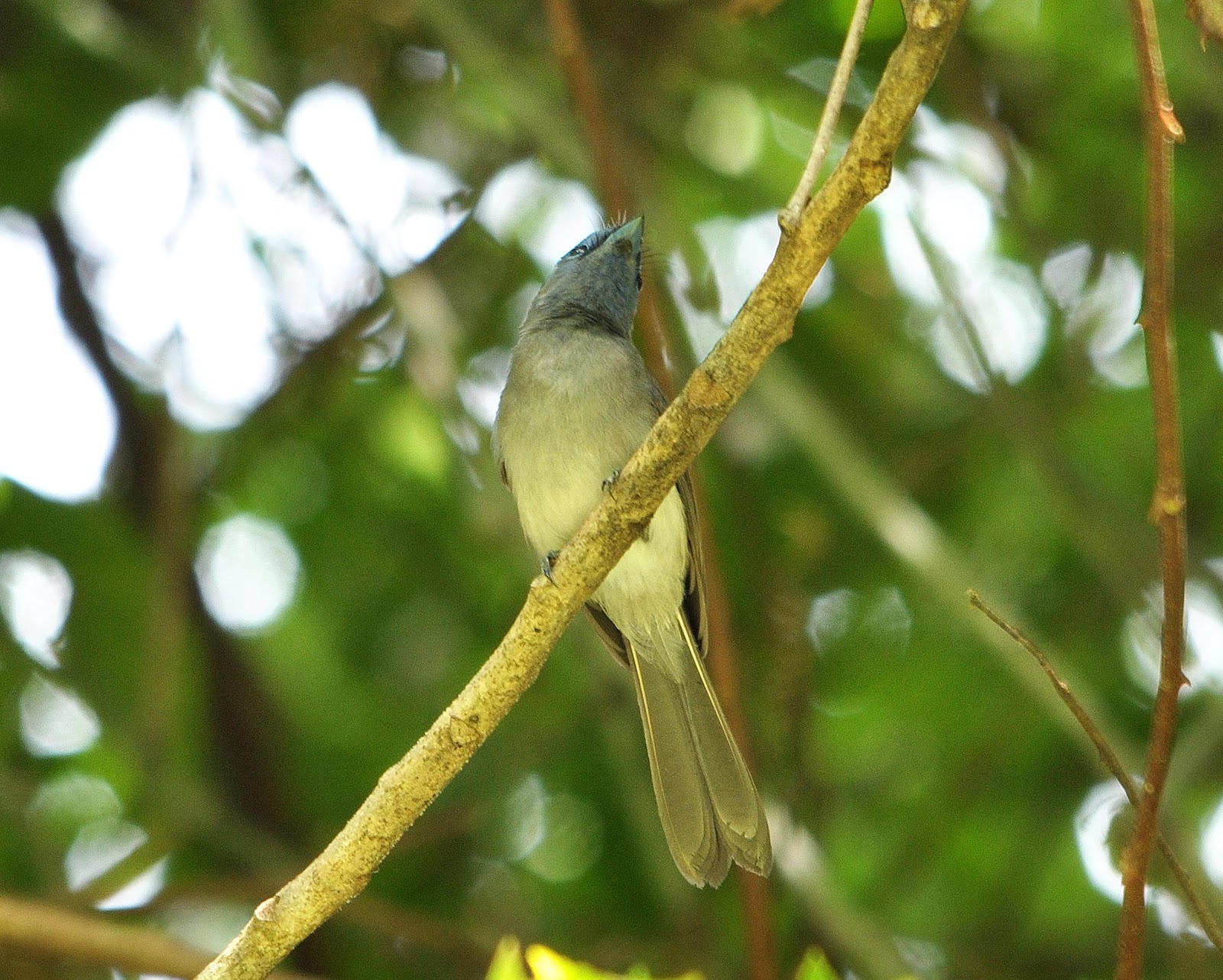
Birding l Female Black-Naped Monarch
Hasil mengendap dalam hutan..matlamat asal nk intai Dusky Munia tapi setelah hampir setengah jam menunggu dalam semak cewek Black Naped yg muncul..alhamdulillah inilah kali pertama dpt tngk burung ni secara live..^^
The Black-naped Monarch or Black-naped Blue Flycatcher (Hypothymis azurea) is a slim and agile passerine bird belonging to the family of monarch flycatchers. They are sexually dimorphic with males having a distinctive black patch on the back of the head and a narrow black half collar ("necklace") while the female is duller and lacks the black markings. They have a call that is similar to that of the Asian Paradise Flycatcher and in tropical forest habitats pairs may join mixed-species foraging flocks. Populations differ slightly in plumage colour and sizes.-http://en.wikipedia.org/wiki/Black-naped_Monarch
Exif:
Bird ID: Female Black-Naped Monarch
Camera Model: Nikon D90
F- stop: F/8
Exposure time: 1/160sec
ISO Speed: ISO-400
Exposure program:A
Exposure Bias: 0.0 step
Focal length: 500mm
Metering mode:spot
White balance:preset
Lens:sigma 150-500
Thursday, May 17, 2012
Banggi Island l Squirrel
Tupai hitam..tak tahu nama saintifiknya jd ambo letak je nama tupai hitam..matlamat asal ambo sebenarnya nak intai burung tp memandangkan hasil yg agak tdk seberapa terpaksa balik awal..ondaway balik ternampak tupai hitam ni sdng melompat-lompat atas dahan kayu sambil menggigit kayu..tak dapat burung tupai pn jadi..bak kata pepatah Melayu, "tak dapat rotan akar pn jadi"
Birding l Oriental Darter
Panjang betul dia punya leher..leher dia tu sekali tengok macam ular pn ada. Orang kita panggil burung ni burung Kosa.
The Oriental Darter or Indian Darter (Anhinga melanogaster ), sometimes called Snakebird, is a water bird of tropical South Asia and Southeast Asia. The Oriental Darter is a member of the darter family, Anhingidae, and is closely related toAmerican (Anhinga anhinga), African (Anhinga rufa), and Australasian (Anhinga novaehollandiae) Darters.-http://en.wikipedia.org/wiki/Oriental_Darter
Tuesday, May 15, 2012
Banggi Island l Moon
Lama tak ambil gambar bulan..sekadar menghilangkan boring..tambahan pulak dah takdak idea nak menulis..sekadar meng'update' blog..sebelum ni ambo membulan menggunakan lens tamron 70-300..sekarang ambo sudah upgrade lens ke sigma 150-500..dgn zoom yg lebih panjang(berbanding sebelum ni) jd hasilnya sedikit berbeza..agak berpuas hati jgklah walaupn hasilnya tdklah seberapa..^^
Saturday, May 12, 2012
Banggi Island l Chameleon
Chameleons (family Chamaeleonidae) are a distinctive and highly specialized clade of lizards. They are distinguished by their parrot-like zygodactylous feet, their separately mobile and stereoscopic eyes, their very long, highly modified, and rapidly extrudable tongues, their swaying gait, the possession by many of a prehensile tail, crests or horns on their distinctively shaped heads, and the ability of some to change color. Colors include pink, blue, red, orange, turquoise, yellow, and green.-http://en.wikipedia.org/wiki/Chameleon
Monday, May 7, 2012
Birding l Eurasian Tree Sparrow
The Eurasian Tree Sparrow (Passer montanus) is a passerine bird in the sparrow family with a rich chestnut crown and nape, and a black patch on each pure white cheek. The sexes are similarly plumaged, and young birds are a duller version of the adult. This sparrow breeds over most of temperate Eurasia and Southeast Asia, where it is known as the Tree Sparrow.-http://en.wikipedia.org/wiki/Eurasian_Tree_Sparrow
Camera Model: Nikon D90
F- stop: F/8
Exposure time: 1/320sec
ISO Speed: ISO320
Exposure program:A
Exposure Bias: -0.3 step
Focal length: 500mm
Metering mode:spot
White balance:Auto
Lens:Sigma 150-500
Flash: No
Handling: Handheld
Friday, May 4, 2012
Wednesday, May 2, 2012
Birding l Welcome Swallow
The Welcome Swallow is metallic blue-black above, light grey below on the breast and belly, and rusty on the forehead, throat and upper breast. It has a long forked tail, with a row of white spots on the individual feathers. These birds are about 15 cm (6 in) long, including the outer tail feathers which are slightly shorter in the female. The call is a mixture of twittering and soft warbling notes, and a sharp whistle in alarm.
Young Welcome Swallows are buffy white, instead of rufous, on the forehead and throat, and have shorter tail streamers.Rujukan@ http://en.wikipedia.org/wiki/Welcome_Swallow
Exif:
ID: Welcome SwallowLoc : Sabah
F-stop: f/8
Exposure time: 1/320sec at ISO 400
White Balance : Auto
Exposure Program : Aperture Priority
Metering Mode : Spot
Flash : No Flash

Focal Length : 500mm
Camera : D90+sigma 150-500mm
Friday, April 27, 2012
Birding l Indian Cuckoo
This is a medium sized cuckoo with both sexes alike. It has grey upperparts while the underside has broad black barring. The tail is barred with a broad subterminal dark band and a white tip. Young birds have white markings on the crown and white chin and throat contrasting with a dark face. Juveniles are browner and have broad white tips to the head and wing feathers. The eye-ring is gray to yellow (a feature shared with the Common Hawk-Cuckoo). The iris is light brown to reddish. The female differs from the male in being slightly paler grey on the throat and in having more brown on the breast and tail. The barring on the belly is narrower than in the male. Nestlings have an orange-red mouth and yellow flanges to the gape.- rujukan@ http://en.wikipedia.org/wiki/Indian_Cuckoo
Gambar kurang jelas sebab terlindung di sebalik daun..lalang pn tinggi-tinggi hampir sama tinggi dgn ambo..huhu..kena redo semula..
ID: Indian Cuckoo..main sorok2 tepi hutan..^^
Loc : tepi rumah kawan
F-stop: f/8
Exposure time: 1/320sec at ISO 500
White Balance : Auto
Exposure Program : Aperture Priority
Metering Mode : Spot
Flash : No Flash
Focal Length : 500mm
Camera : D90+sigma 150-500mm
Subscribe to:
Posts (Atom)